How Bitcoin Solves Double-Spending: The Blockchain Mechanism Explained
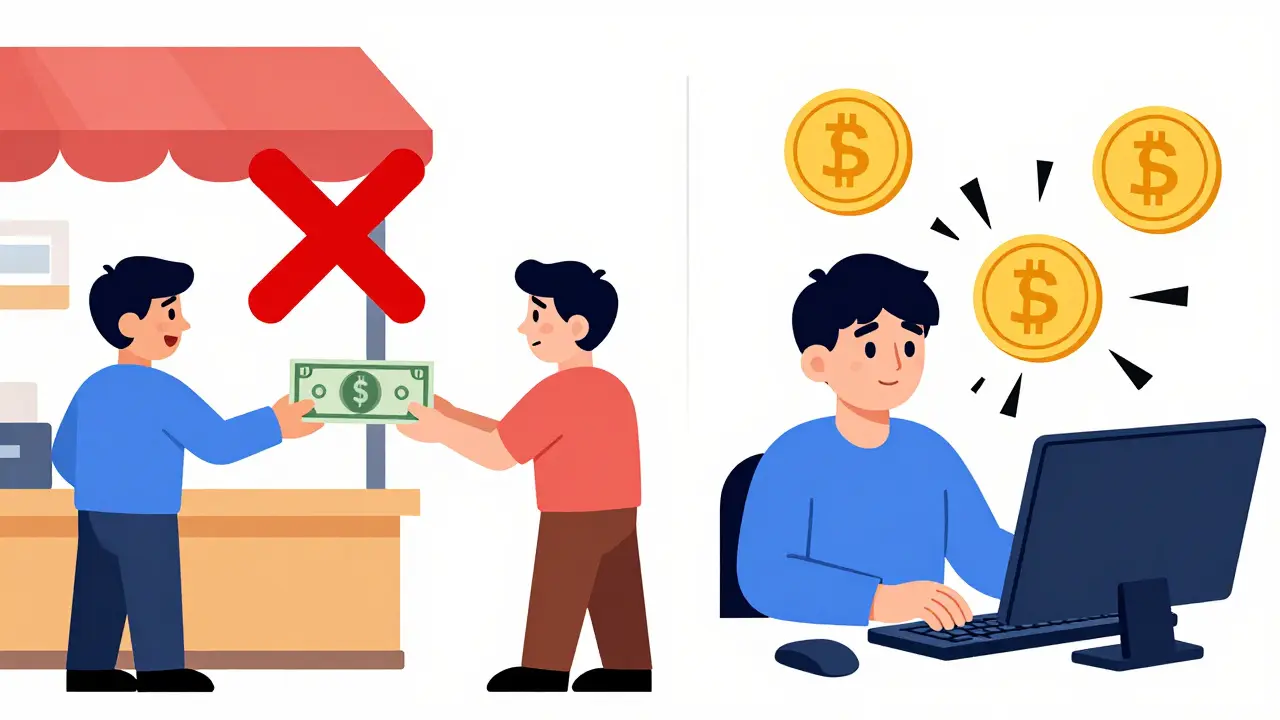
Imagine you send a digital file to two different friends at the exact same time. Because digital files are just copies of data, both friends get the file, and you still have the original. Now, imagine if money worked that way. You could spend the same $10 bill on coffee in one shop and lunch in another, simultaneously. In the physical world, this is impossible because the cash leaves your hand. In the digital world, however, it’s easy to copy-paste value. This is the double-spending problem.
For decades, this was the reason we needed banks. They act as the referee, checking their private ledger to ensure you didn’t spend your funds twice. But what if you want to send money directly to someone else, without a bank? That is exactly what Bitcoin is a decentralized digital currency system that allows peer-to-peer transactions without intermediaries was designed to do. Created by the pseudonymous Satoshi Nakamoto who published the Bitcoin whitepaper in October 2008 outlining the technical foundation for decentralized digital cash, Bitcoin solves this problem not with a trusted middleman, but with math, cryptography, and a global network of computers.
The Core Problem: Why Digital Money Needs a Referee
To understand how Bitcoin fixes double-spending, you first need to see why it breaks in other systems. Traditional digital payments rely on centralized databases. When you swipe your credit card, Visa or Mastercard checks their central server. They look up your account balance, verify the funds exist, and then deduct them. If someone tries to spend those same funds elsewhere, the central server says, "No, those funds are already gone."
This works fine until you remove the center. In a peer-to-peer network where everyone connects directly to each other, there is no single source of truth. If Alice sends Bob 1 BTC, she can also send Charlie 1 BTC using the same digital signature. Without a central authority to say which transaction happened first, both Bob and Charlie might think they received valid payment. This is the double-spend attack.
Before Bitcoin, attempts to create digital cash failed because they couldn't solve this coordination problem without a central server. Bitcoin’s breakthrough was creating a system where thousands of strangers could agree on the state of the ledger without trusting each other.
The Solution: A Shared Public Ledger (Blockchain)
Bitcoin replaces the central bank’s private ledger with a public, distributed ledger called the Blockchain is an immutable, chronologically ordered database of transactions maintained by a global network of nodes. Think of it as a Google Doc that everyone can read, but only one person can edit at a time, and once edited, the text cannot be changed or deleted.
Here is how it prevents double-spending step-by-step:
- Broadcasting: When you initiate a transaction, you broadcast it to the entire network. You don’t send it to a bank; you shout it out to thousands of computers (nodes) worldwide.
- Verification: Each node checks the transaction against its own copy of the ledger. It looks at the specific inputs you are spending. Have those inputs been spent before? If yes, the node rejects the transaction immediately. If no, it accepts it into a waiting area called the mempool.
- Ordering: Nodes group these pending transactions into a block. Crucially, they must agree on the order of transactions. If two conflicting transactions exist (Alice sending to Bob AND Alice sending to Charlie), the network must decide which one is valid. The rule is simple: the first one included in a confirmed block wins.
- Consensus: Once a block is added to the chain, the entire network updates its ledger. The winning transaction is now history. The losing transaction is discarded as invalid because its inputs are now marked as "spent" in the new block.
This shared visibility means that double-spending is instantly visible. If you try to spend the same coin twice, the second attempt will fail because the network has already recorded the first spend.
Proof of Work: Making Fraud Expensive
So far, we’ve established that nodes check transactions. But what stops a malicious actor from rewriting history? What if I mine a block that includes my double-spend transaction, and then convince the network to ignore the previous block?
This is where Proof of Work (PoW) is the consensus mechanism requiring miners to solve complex cryptographic puzzles to add blocks, securing the network through energy expenditure comes in. PoW is the engine that drives security.
Miners compete to solve a difficult mathematical puzzle. This process requires massive amounts of computational power and electricity. The first miner to solve the puzzle gets to add the next block to the blockchain and receives a reward (newly minted bitcoins plus transaction fees).
Why does this stop double-spending? Because changing a past transaction requires redoing the Proof of Work for that block AND every block after it. To successfully double-spend, an attacker would need to:
- Create a secret chain of blocks starting from the moment before their transaction.
- Mine faster than the rest of the honest network combined.
- Catch up to the length of the public blockchain.
If the attacker controls less than 51% of the network’s computing power (hash rate), they are statistically unlikely to win this race. As of 2024, the Bitcoin network’s hash rate exceeded 400 exahashes per second. Attempting to overpower this would require more hardware and electricity than most nations consume, making the cost of the attack far higher than any potential gain from double-spending.

Transaction Confirmations: Waiting for Finality
In Bitcoin, a transaction isn’t considered "final" the moment it enters a block. It gains security over time through confirmations. Each new block added to the chain counts as one confirmation.
| Confirmations | Time Estimate | Security Level | Recommended Use Case |
|---|---|---|---|
| 0 | Instant | Low (Unconfirmed) | Small peer-to-peer tips only; high risk of reversal. |
| 1 | ~10 minutes | Medium | Small purchases under $100; low risk. |
| 3-6 | 30-60 minutes | High | Standard merchant acceptance; very low risk. |
| 6+ | 1+ hour | Very High (Final) | Large value transfers; exchange deposits; near-zero risk. |
Why six confirmations? With each additional block, the amount of work required to reverse the transaction grows exponentially. By the time a transaction has six confirmations, it would require an attacker to outmine the entire honest network for an hour straight to rewrite that history. For all practical purposes, a transaction with six confirmations is irreversible. This gives merchants confidence that the coins they received cannot be double-spent later.
Economic Incentives: Why Miners Play Fair
Technology alone doesn’t secure Bitcoin; economics does. The system is designed so that it is always more profitable to follow the rules than to break them.
Miners spend real money on hardware and electricity. In return, they earn block rewards and transaction fees. If a miner tries to cheat by including a double-spend transaction, the network will reject their block. They waste their time and energy, earning nothing. Honest miners, who include valid transactions, get paid.
Furthermore, attacking the network would devalue Bitcoin itself. If people believe Bitcoin is insecure and susceptible to double-spending, they will sell their holdings. Since many miners hold significant amounts of Bitcoin, a crash in price would destroy their own wealth. This alignment of incentives ensures that the vast majority of participants are economically motivated to protect the integrity of the ledger.

Comparison: Centralized vs. Decentralized Prevention
It helps to see how Bitcoin’s approach differs from traditional finance.
| Feature | Traditional Banking (Visa/Mastercard) | Bitcoin Network |
|---|---|---|
| Authority | Centralized institution | Distributed network of nodes |
| Trust Model | Trust the intermediary | Trust the code and cryptography |
| Reversibility | Yes (chargebacks possible) | No (immutable after confirmations) |
| Cost of Attack | Hacking the central database | Controlling 51% of global hash rate |
| Transparency | Private ledgers | Public, auditable ledger |
The key difference is trust. In banking, you trust that the bank won’t make mistakes or be corrupted. In Bitcoin, you trust that the economic and mathematical laws governing the network will prevent fraud. There is no single point of failure.
Edge Cases: Replace-by-Fee and Mempool Risks
While Bitcoin is robust, it is not magic. There are edge cases, primarily during the unconfirmed period (0 confirmations). If you broadcast a transaction with a low fee, it might sit in the mempool for hours. During this time, you could theoretically broadcast a second transaction with a higher fee that spends the same inputs. This is called Replace-by-Fee (RBF) is a policy allowing users to replace an unconfirmed transaction with a new one offering a higher fee.
RBF is actually a feature, not a bug, as it helps transactions get confirmed faster when network congestion occurs. However, for merchants accepting unconfirmed payments, this poses a risk. A customer could pay, receive goods, and then RBF their transaction to send the money back to themselves. This is why reputable merchants wait for at least one confirmation before delivering high-value goods. For small amounts, some merchants accept zero-conf transactions based on statistical risk models, but they accept the inherent risk of rare double-spend attempts.
Conclusion: Security Through Scarcity and Consensus
Bitcoin solves double-spending by replacing institutional trust with cryptographic proof and economic incentives. It creates a global clock that orders transactions objectively. It makes altering history computationally expensive and economically irrational. And it provides a transparent ledger that anyone can audit.
You don’t need to trust the person sending you money. You don’t need to trust a bank. You just need to trust the math. As long as the majority of the network remains honest-or at least indifferent to breaking the protocol-double-spending remains a theoretical impossibility for confirmed transactions. This innovation is why Bitcoin remains the most secure digital asset in existence today.
What happens if I try to double-spend Bitcoin?
If you attempt to double-spend, the network will detect the conflict. The first transaction to be included in a confirmed block will be accepted as valid. The second transaction will be rejected by nodes because the inputs have already been marked as spent. Your second transaction will simply fail, and you will lose the transaction fee associated with it.
Can a 51% attack cause double-spending?
Theoretically, yes. If a single entity controls more than 50% of the network's hash rate, they could potentially rewrite recent blocks to reverse transactions. However, this is extremely difficult and expensive due to the sheer size of the Bitcoin network. Additionally, such an attack would likely crash the value of Bitcoin, harming the attacker's own holdings. No successful 51% attack has ever occurred on the main Bitcoin network.
Why do I need 6 confirmations for large transactions?
Each confirmation adds a layer of security. With 6 confirmations, an attacker would need to outmine the entire honest network for approximately one hour to reverse the transaction. This makes the probability of a successful double-spend attack negligible for high-value transfers. For smaller amounts, fewer confirmations may be acceptable depending on the merchant's risk tolerance.
Is Bitcoin double-spending prevention better than banks?
Bitcoin offers stronger protection against unilateral reversal. Banks allow chargebacks, which can be abused by customers to dispute legitimate charges. Bitcoin transactions are irreversible once confirmed, providing certainty for merchants. However, banks offer consumer protections like fraud recovery, which Bitcoin lacks. Bitcoin shifts the burden of security to the user but removes counterparty risk from the network level.
How do nodes verify that a transaction hasn't been double-spent?
Nodes maintain a complete copy of the UTXO set (Unspent Transaction Outputs). When a new transaction arrives, the node checks if the inputs referenced in the transaction exist in the UTXO set and have not been spent in any previously confirmed block. If the inputs are already spent, the node rejects the transaction immediately.