Probabilistic vs Absolute Finality: Which Blockchain Settlement Is Right for You?

Imagine you just sent $10,000 to a friend. You hit 'send,' and the screen says 'Transaction Complete.' Do you spend that money? Do you trust your friend has it? In traditional banking, the answer is usually yes. But in the world of blockchain technology, which is a decentralized digital ledger system that records transactions across multiple computers so that any involved record cannot be altered retroactively, the answer depends entirely on one critical concept: finality.
This isn't just a technical nuance for developers; it’s the difference between sleeping soundly and worrying about a double-spend attack. The core debate centers on two distinct models: probabilistic finality, where security grows over time but never hits 100%, and absolute finality, also known as deterministic finality, where a transaction is irreversible the moment it is confirmed. Understanding this split is essential whether you are building a decentralized application, running a node, or simply trying to understand why Bitcoin takes longer to settle than Algorand.
The Mechanics of Probabilistic Finality
Probabilistic finality is the model most people encounter first because it powers Bitcoin, the original cryptocurrency created by Satoshi Nakamoto in 2009 that uses proof-of-work consensus. When you send Bitcoin, the transaction enters a mempool (a waiting area) until a miner includes it in a block. At that exact second, the transaction is not yet 'final' in the strictest sense. It is only 'confirmed once.'
Here is how the math works. As more blocks are added on top of the block containing your transaction, the computational effort required to reverse that transaction increases exponentially. If an attacker wants to steal those funds back, they must mine a longer chain starting from the block before yours was included. This is called a reorganization or 'reorg.'
- 1 Confirmation: Low security. A powerful miner could potentially orphan your block.
- 3 Confirmations: Moderate security. Suitable for small purchases like coffee.
- 6 Confirmations: High security. This is the industry standard for exchanges and high-value transfers. It takes roughly 60 minutes on Bitcoin.
The beauty of this system is its decentralization. Bitcoin relies on Proof-of-Work (PoW), a consensus mechanism where miners solve complex mathematical puzzles to validate transactions and secure the network. Anyone with hardware can join. As of 2024, Bitcoin had over 15,000 reachable nodes globally. No single entity controls the network. However, the trade-off is speed and energy. Bitcoin processes about 7 transactions per second (TPS) and consumes approximately 150 TWh of electricity annually-roughly the consumption of a medium-sized country.
Even Ethereum, the leading smart contract platform that transitioned from proof-of-work to proof-of-stake in 2022, largely operates on probabilistic principles for its base layer, though it introduces hybrid elements we will discuss later. For years, Ethereum users waited for 12-30 confirmations to feel safe, mirroring Bitcoin’s cautious approach.
The Promise of Absolute Finality
Now, let’s look at the other side of the coin: absolute finality. Here, when a transaction is committed, it is done. Period. There is no probability curve. There is no waiting for six blocks. This is achieved through Byzantine Fault Tolerance (BFT), a consensus algorithm that allows a distributed computer network to reach agreement even if some nodes fail or act maliciously.
In a BFT system, validators communicate with each other in rounds. They propose a block, vote on it, and commit to it. Once a supermajority (typically 2/3 + 1) of validators agree, the block is finalized. If a validator tries to lie or change their vote, they are 'slashed'-their staked tokens are destroyed. This creates immediate, mathematical certainty.
Networks like Algorand, which uses Pure Proof-of-Stake consensus to achieve instant finality and high throughput and Cosmos, which utilizes Tendermint BFT consensus to enable interoperable blockchains excel here. Algorand claims capabilities exceeding 1,000 TPS with sub-second finality. Cosmos networks offer similar speeds. This makes them ideal for payments, gaming, and high-frequency trading where waiting 10 minutes for a settlement is unacceptable.
However, there is a catch. BFT protocols struggle with scale. To maintain fast communication between all validators, the network size must remain relatively small. While Bitcoin has thousands of nodes, many absolute finality networks operate with hundreds of active validators. This raises concerns about centralization. If only a few entities run the majority of validators, does the network truly resist censorship?

Comparing the Trade-offs: Speed vs. Decentralization
| Feature | Probabilistic Finality | Absolute Finality |
|---|---|---|
| Consensus Mechanism | Proof-of-Work (PoW), Proof-of-Stake (PoS) | Byzantine Fault Tolerance (BFT), PBFT |
| Time to Finality | Minutes to Hours (e.g., 60 mins for BTC) | Seconds (e.g., < 1 sec for ALGO) |
| Reversibility Risk | Non-zero, decreases exponentially | Zero (after commitment) |
| Decentralization Potential | High (Thousands of nodes) | Moderate (Hundreds of validators) |
| Energy Consumption | High (PoW) / Low (PoS) | Very Low |
| Primary Use Case | Store of Value, Censorship Resistance | PAYments, DeFi, Enterprise Apps |
The choice isn't just technical; it's philosophical. Do you prioritize the ability of anyone, anywhere, to participate in securing the network (Bitcoin’s ethos)? Or do you prioritize efficiency, speed, and user experience (the goal of many newer chains)?
Vitalik Buterin, co-founder of Ethereum, famously argued that "finality is always probabilistic." He points out that even traditional banks can reverse transactions due to fraud or legal orders. Therefore, he suggests we shouldn't fear probabilistic finality. However, this view is contested. In the context of smart contracts, where code executes automatically based on state changes, ambiguity is dangerous. If a DeFi protocol assumes a deposit is final, but it gets reverted, the entire system can break. This is why many DeFi applications prefer absolute finality.
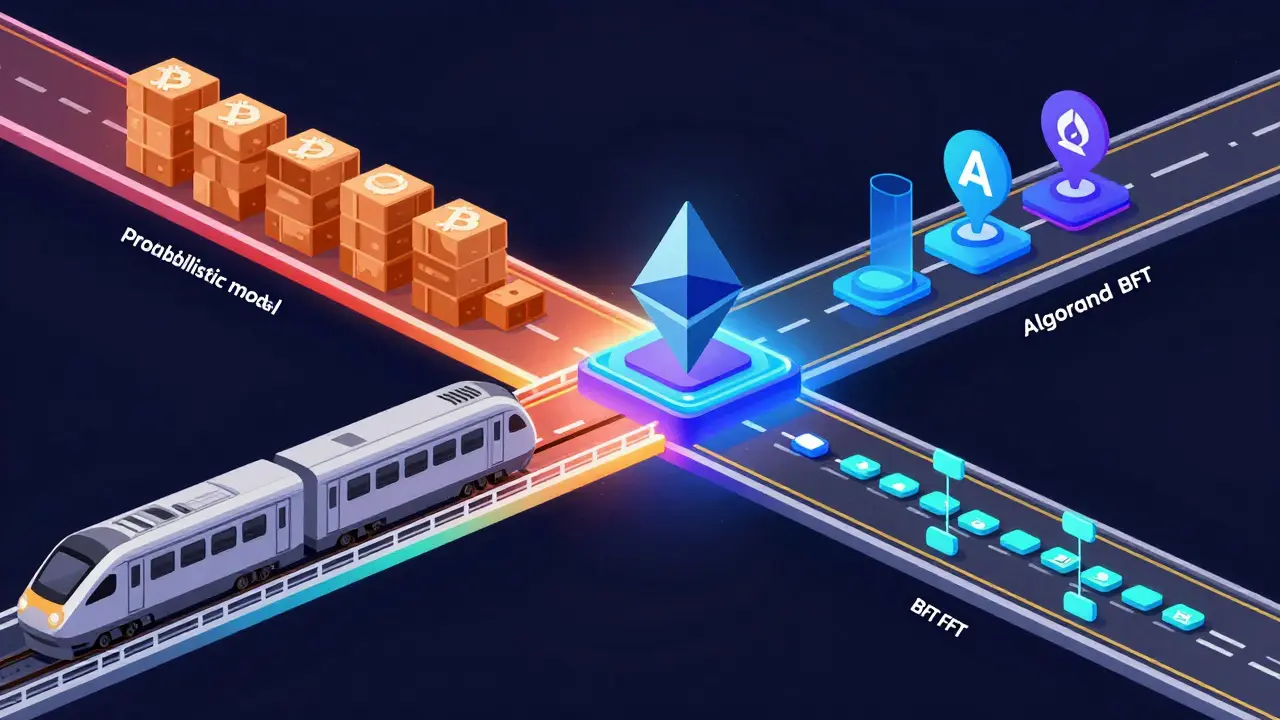
Hybrid Approaches and the Future Landscape
The industry is moving toward a middle ground. Pure probabilistic systems are too slow for modern apps, and pure BFT systems often sacrifice too much decentralization. Enter hybrid models.
Ethereum’s transition to Proof-of-Stake introduced Casper FFG, a finality gadget that adds a layer of absolute finality to Ethereum’s probabilistic base layer. Validators still produce blocks probabilistically, but they periodically vote on 'checkpoints.' Once a checkpoint is justified and finalized, it becomes immutable. This gives Ethereum the best of both worlds: high throughput and eventual absolute finality, albeit with a delay of ~12 minutes for full finality.
Layer-2 solutions also play a crucial role. Lightning Network, a second-layer scaling protocol built on top of Bitcoin that enables instant, low-cost transactions, allows users to conduct millions of micro-transactions off-chain with immediate finality. These channels are then settled on the main Bitcoin chain, inheriting its probabilistic security. This architecture lets Bitcoin remain secure and decentralized while offering users a near-instant payment experience.
We are also seeing the rise of 'fractional finality' concepts. Some research proposes allowing users to choose their security level. Want your transaction confirmed in 2 seconds? Pay a higher fee and accept a tiny risk. Wait 10 minutes? Pay less and get near-certainty. This flexibility could redefine how we interact with blockchains.
Which Model Should You Choose?
Your decision depends on your specific needs. Here is a quick guide:
- For Store of Value: Stick with probabilistic finality. Bitcoin’s proven track record, massive hash rate, and unparalleled decentralization make it the gold standard for long-term holding. The slight delay in settlement is irrelevant when you aren’t spending daily.
- For Payments and Commerce: Absolute finality wins. Merchants hate chargebacks and delays. Networks like Algorand or Solana (which uses a probabilistic model but achieves practical finality quickly via PoH) provide the speed needed for point-of-sale systems.
- For DeFi and Smart Contracts: Look for absolute or hybrid finality. Complex financial instruments require certainty. If a loan liquidation triggers, it must happen instantly and irreversibly. Ethereum L2s and Cosmos-based chains are strong contenders here.
- For Enterprise Applications: Absolute finality is often preferred due to compliance and audit requirements. Knowing exactly when a transaction is legally binding simplifies integration with legacy systems.
Remember, there is no 'best' blockchain. There is only the right tool for the job. As the technology matures, expect to see more interoperability between these models. You might send Bitcoin to a bridge, convert it to an asset on a BFT chain for fast trading, and then bridge it back. The future is likely a multi-chain ecosystem where probabilistic and absolute finality coexist, serving different layers of the global economy.
What is the main difference between probabilistic and absolute finality?
Probabilistic finality means a transaction becomes more secure over time as more blocks are added, but there is always a tiny chance it could be reversed. Absolute finality means a transaction is irreversible immediately after confirmation, with zero chance of reversal.
Why does Bitcoin use probabilistic finality?
Bitcoin uses probabilistic finality via Proof-of-Work to maximize decentralization and security. It allows anyone to join the network as a miner without needing permission or trusting a central group of validators. The trade-off is slower settlement times.
Is absolute finality safer than probabilistic finality?
It depends on the threat model. Absolute finality protects against double-spends immediately but relies on a smaller set of trusted validators, which can be a centralization risk. Probabilistic finality offers stronger economic security against large-scale attacks but requires waiting for confirmations.
Which blockchains use absolute finality?
Notable examples include Algorand (Pure Proof-of-Stake), Cosmos (Tendermint BFT), Ripple (Federated Consensus), and Stellar. These networks prioritize speed and immediate settlement.
How does Ethereum handle finality?
Ethereum uses a hybrid approach. It produces blocks probabilistically using Proof-of-Stake, but employs Casper FFG to provide absolute finality for epochs (groups of blocks). This balances speed with security.
Can a transaction with absolute finality ever be reversed?
Technically, no. Once the required number of validators (usually 2/3 + 1) have signed off on a block, it is cryptographically impossible to revert it without compromising the security assumptions of the network (e.g., stealing private keys).
Why do merchants prefer absolute finality?
Merchants want to deliver goods or services immediately upon payment. With probabilistic finality, they risk sending a product that could theoretically be reversed if the buyer launches a 51% attack (though rare). Absolute finality eliminates this uncertainty.
What is the CAP theorem's role in finality?
The CAP theorem states that a distributed system can only guarantee two of three properties: Consistency, Availability, and Partition Tolerance. Probabilistic systems often favor Availability and Partition Tolerance, accepting temporary inconsistency. Absolute finality systems favor Consistency and Partition Tolerance, potentially sacrificing Availability during network issues.