Understanding DeFi Protocols and Applications: A Practical Guide for 2026
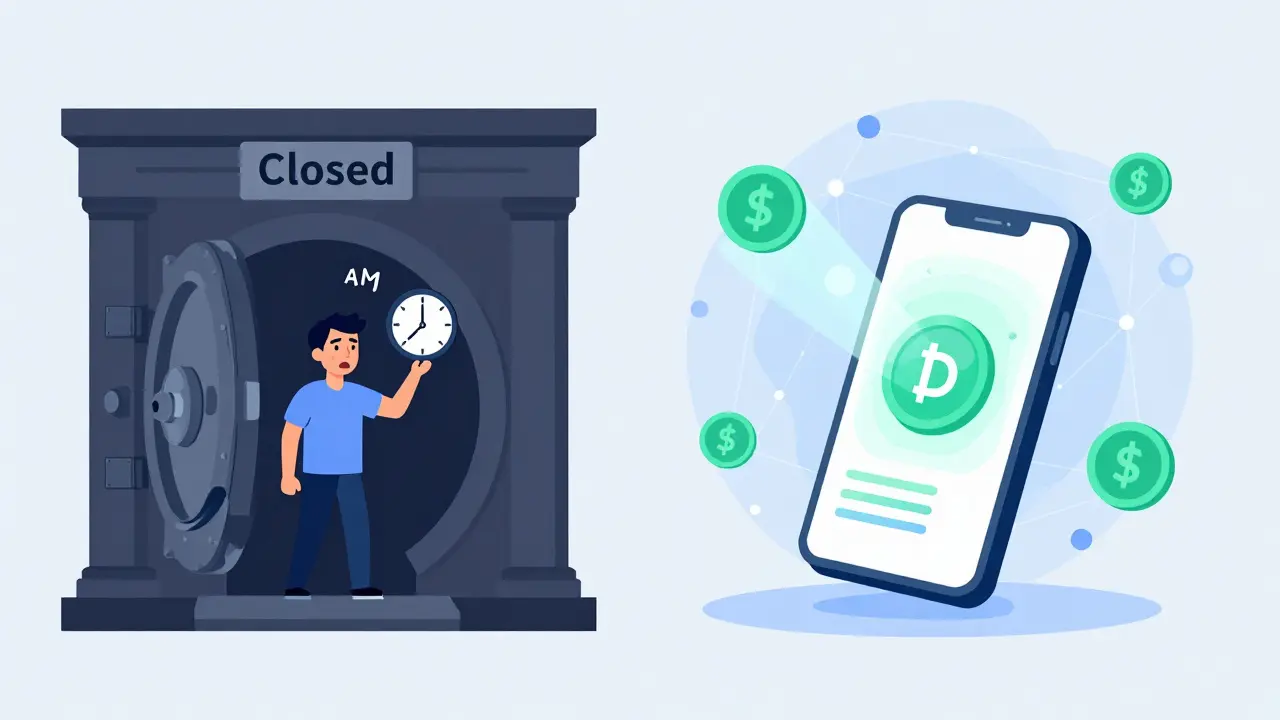
Imagine walking into a bank at 3 AM to take out a loan. You’d be turned away. Now imagine doing that same transaction on your phone, instantly, without asking anyone for permission. That is the core promise of Decentralized Finance (DeFi), which is a financial system built on blockchain technology that operates without traditional intermediaries like banks or brokers. It replaces trust in institutions with trust in code.
If you have heard buzzwords like "liquidity pools," "yield farming," or "smart contracts" and felt lost, you are not alone. The landscape has shifted dramatically since the early days of Ethereum. As we move through 2026, DeFi is no longer just for crypto enthusiasts; it is becoming a critical piece of global financial infrastructure. But how does it actually work? And more importantly, is it safe for your money?
How DeFi Protocols Actually Work
To understand DeFi, you need to forget everything you know about centralized banking. In a traditional bank, a ledger kept by employees tracks who owns what. In DeFi, that ledger is public, immutable, and stored across thousands of computers worldwide. This is the blockchain.
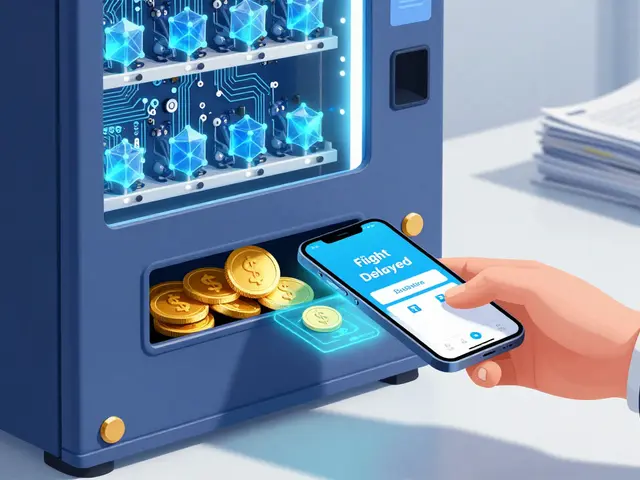
The engine driving this system is the smart contract, which is a self-executing program deployed on a blockchain that automatically handles financial transactions when specific conditions are met. Think of a smart contract like a vending machine. You put in money (input), select a product (logic), and the machine dispenses the snack (output). No cashier is needed. If the code says "if User A sends $100, send them $100 worth of Bitcoin," that happens automatically. There is no middleman taking a cut or deciding to reject your request.
This architecture enables several key benefits:
- Permissionless Access: Anyone with an internet connection can use these services. No credit checks, no KYC forms, no waiting periods.
- Transparency: Every transaction is visible on the blockchain. You can audit the protocol’s health in real-time.
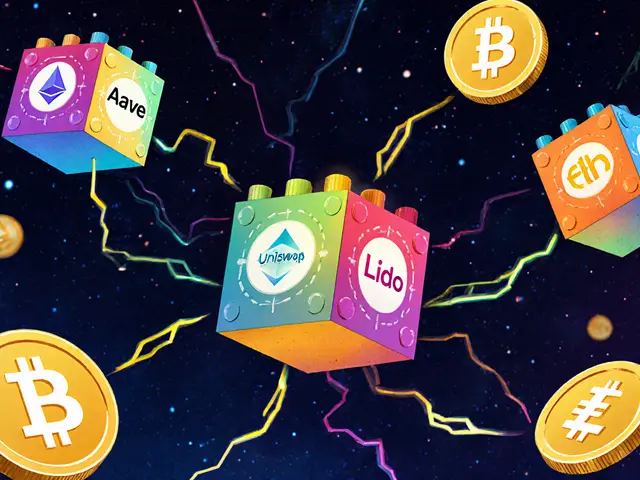
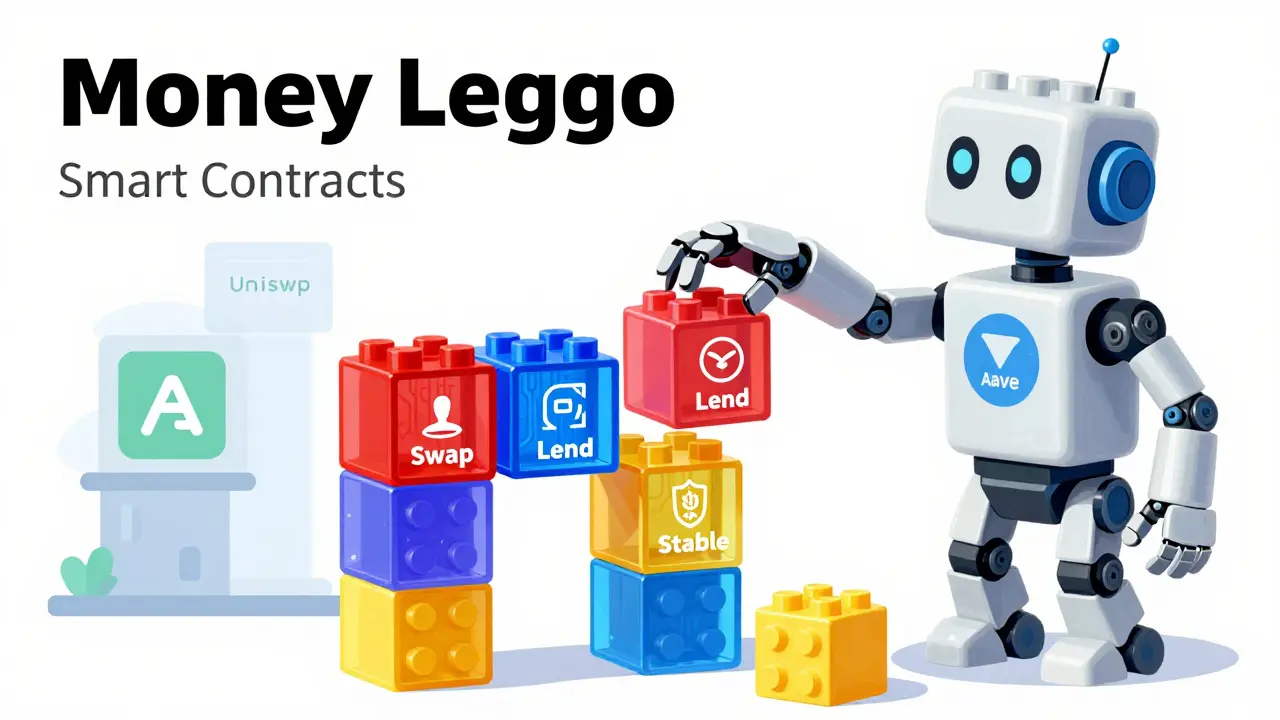
- Interoperability: Different DeFi apps can connect and work together, often referred to as "money Legos."
However, this freedom comes with responsibility. Because there is no customer support hotline, if you make a mistake-like sending funds to the wrong address-they are gone forever. Understanding the mechanics is your first line of defense.
Core Categories of DeFi Applications
DeFi isn't just one thing; it is an ecosystem of different tools designed to replicate traditional financial services. Here are the main categories you will encounter.
Decentralized Exchanges (DEXs)
Traditional exchanges like Coinbase or Binance hold your assets. DEXs do not. Instead, they use Automated Market Makers (AMMs), which are algorithmic systems that facilitate trading between users via liquidity pools rather than order books.
Uniswap is the dominant player here, handling over $1.2 trillion in trading volume in 2025. With its v4 upgrade launched in June 2025, Uniswap introduced "hooks," allowing developers to customize trading logic. For a regular user, this means deeper liquidity and better prices. When you swap tokens on Uniswap, you are trading directly against a pool of funds provided by other users, not a market maker.
Lending and Borrowing Platforms
You can lend your crypto to earn interest or borrow against your holdings without liquidating them. Aave leads this space with $18.7 billion in outstanding loans as of late 2025. Unlike a bank loan, you must over-collateralize. If you want to borrow $1,000 worth of USDC, you might need to lock up $1,500 worth of Ethereum. If the value of your Ethereum drops too low, the protocol automatically sells your collateral to repay the loan. This is called liquidation, and it happens instantly via smart contracts.
Stablecoin Protocols
Volatility is a problem for daily transactions. Stablecoins solve this by pegging their value to fiat currencies like the US Dollar. MakerDAO issues DAI, a decentralized stablecoin that maintained a 99.87% peg accuracy in 2025. MakerDAO is unique because it is governed by its token holders, making decisions about risk parameters and collateral types through a complex voting process.
Comparing Top DeFi Protocols
Not all protocols are created equal. Choosing the right one depends on your goal: swapping, earning yield, or borrowing. Here is how the leaders stack up in 2026.
| Protocol | Primary Function | Key Feature | Risk Factor |
|---|---|---|---|
| Uniswap | Trading (DEX) | Concentrated Liquidity (v3/v4) | Impermanent Loss for LPs |
| Aave | Lending/Borrowing | Cross-chain Collateral (v4) | Liquidation Risk |
| Curve Finance | Stablecoin Swaps | Low Slippage (0.04% avg) | Complex Interface |
| MakerDAO | Stablecoin Issuance | Endgame Governance Structure | Governance Slowdowns |
Uniswap is best for general token swaps due to its deep liquidity. However, providing liquidity on Uniswap carries "impermanent loss," where volatility can cause you to lose value compared to simply holding the assets. In 2024's volatile market, some liquidity providers saw losses of 30-40%.
Aave is optimal for borrowers who want flexible rates. Its v4 update allows cross-chain collateral, meaning you can lock assets on Polygon and borrow on Ethereum. The catch? If the market crashes, your collateral gets liquidated fast. During the March 2023 UST depegging event, many users had seconds to react before losing their funds.
Curve Finance dominates stablecoin trading. If you are moving large amounts of USDC or DAI, Curve offers minimal slippage. But its interface is notoriously confusing for beginners. One Reddit user reported losing $150 in their first deposit due to selecting the wrong token pair-a common pitfall.
Getting Started: A Step-by-Step Guide
Entering DeFi requires a few technical steps. Do not rush this. According to Consensys' 2025 user study, the learning curve for basic interactions is 3-5 hours. Take your time.
- Set Up a Non-Custodial Wallet: Download MetaMask, which is a browser extension and mobile app that serves as a gateway to Ethereum-based applications. Write down your seed phrase on paper. Never store it digitally. If you lose this phrase, you lose access to your funds forever.
- Acquire Network Tokens: You need ETH (or MATIC, AVAX, etc., depending on the chain) to pay for gas fees. Buy a small amount ($5-$10) from a centralized exchange and withdraw it to your wallet address.
- Connect to a Protocol: Go to a reputable site like Uniswap.org or Aave.com. Click "Connect Wallet" and approve the connection in MetaMask.
- Start Small: Perform a test transaction. Swap $1 worth of ETH for USDC. Check the gas fee. If it seems high, wait for network congestion to drop. Layer 2 networks like Arbitrum or Optimism offer much lower fees ($0.02-$0.50).
Avoid clicking links from social media. Phishing sites are rampant. Always type the URL manually or use a verified bookmark. In 2025, 47% of DeFi users reported phishing attempts targeting their seed phrases.
Risks and Realities in 2026
DeFi is powerful, but it is not risk-free. The total value locked (TVL) dropped from $214 billion in early 2025 to $156 billion by October 2025. This wasn't a collapse, but a maturation. Users moved capital from risky, high-yield farms to more secure, established protocols.
Smart Contract Vulnerabilities: Code can have bugs. In 2024, hackers stole $1.2 billion from DeFi protocols via exploits. While audits by firms like OpenZeppelin help, no code is perfect. Stick to battle-tested protocols like Aave and Uniswap rather than new, unproven projects promising 1000% APY.
Regulatory Uncertainty: The legal landscape is fragmented. The EU’s MiCA framework requires KYC for stablecoin issuers, while the US lacks federal clarity. In September 2025, Caitlin Long warned that regulatory fragmentation could force shutdowns in unclear jurisdictions. Keep an eye on local laws.
Impermanent Loss: If you provide liquidity, remember that price divergence hurts you. Use calculators to estimate potential losses before committing funds.
The Future: AI and Real-World Assets
Where is DeFi heading? Two trends are reshaping the industry in 2026.
First, DeFAI (DeFi + AI). Wendy O from Bankless noted that AI integration reduced arbitrage opportunities by 63% while improving risk assessment. Protocols are using AI to optimize yield strategies dynamically, capturing 22% of new TVL in the first half of 2025.
Second, Real-World Asset (RWA) Tokenization. The World Economic Forum predicts RWA tokenization will grow from $10 billion to $160 billion by 2027. Institutions like BlackRock and JPMorgan are already deploying billions into tokenized funds via DeFi protocols like Ondo Finance. This bridges the gap between traditional finance and crypto, bringing stability and legitimacy.
By 2027, Gartner predicts 30% of traditional financial products will have DeFi counterparts. The era of "wild west" DeFi is ending; the era of institutional-grade decentralized finance is beginning.
Is DeFi safer than a traditional bank?
It depends on what you mean by safe. Traditional banks are insured by governments (e.g., FDIC), so if the bank fails, you get your money back. DeFi has no insurance. However, DeFi is transparent; you can see exactly where your money is. Banks are opaque. The risk in DeFi is technical (bugs/hacks) and user error (losing keys). In banks, the risk is systemic failure or fraud. For tech-savvy users who manage their own security, DeFi can be very safe. For others, the lack of recourse makes it riskier.
What are gas fees, and why do they vary?
Gas fees are payments made to miners or validators to process transactions on the blockchain. They vary based on network congestion. When many people are using Ethereum, fees spike. To save money, use Layer 2 solutions like Arbitrum, Optimism, or Polygon, which bundle transactions and settle them on Ethereum later, reducing costs by up to 97%.
Can I lose my money in DeFi even if I don't trade?
Which DeFi protocol is best for beginners?
Uniswap is widely considered the most beginner-friendly for simple swaps due to its clean interface and extensive documentation. For lending, Aave is robust and well-audited. Avoid complex yield farming strategies until you fully understand impermanent loss and smart contract risks. Start with small amounts to learn the mechanics.
How does regulation affect DeFi in 2026?
Regulation is increasing. The EU's MiCA framework imposes strict rules on stablecoin issuers. In the US, state-level actions are creating a patchwork of compliance requirements. This may lead to fewer anonymous options and more KYC-integrated DeFi platforms. Users should stay informed about laws in their jurisdiction to avoid legal issues.