Bitcoin: What It Is, How It Works, and Why It Still Matters
When people talk about Bitcoin, the first decentralized digital currency that runs on a public ledger called blockchain. Also known as BTC, it was created in 2009 to let people send money without banks. Unlike regular cash, Bitcoin isn’t controlled by any government or company. It moves across a global network of computers, and every transaction is locked in a chain of blocks—hence the name blockchain, a public, tamper-proof record of all Bitcoin transactions. This system makes it nearly impossible to fake or double-spend coins.
Bitcoin’s value doesn’t come from a company’s promise or a central bank’s backing. It comes from scarcity and work. Only 21 million Bitcoins will ever exist, and new ones are added through a process called Proof of Work, a consensus method where miners solve complex math problems to verify transactions and earn new Bitcoin. This isn’t just tech jargon—it’s what keeps the network secure. Every two weeks, the system automatically adjusts the mining difficulty to keep new blocks coming every 10 minutes, no matter how many miners join or leave. That’s why mining difficulty, a measure of how hard it is to find a new block keeps rising as more powerful machines enter the game.
Bitcoin isn’t just about mining or tech. It’s also about how people use it. Some hold it long-term, betting it’ll go up. Others trade it daily, reacting to news, regulations, or market panic. In places like India, traders face a 30% tax on every profit. In China, owning Bitcoin is outright banned. Meanwhile, exchanges and wallets—like MetaMask or hardware devices—let you store it, but each choice comes with trade-offs between convenience and safety. Even meme coins and DeFi tokens now ride on Bitcoin’s coattails, using its network as a benchmark for trust.
What you’ll find below isn’t a list of hype or fluff. It’s a collection of real, no-BS breakdowns—some about Bitcoin’s core mechanics, others about how it shapes everything from taxes to exchange rules. You’ll see how mining difficulty keeps the network stable, how crypto bans affect real people, and why some tokens fail while Bitcoin still stands. No fluff. No promises. Just facts you can use.
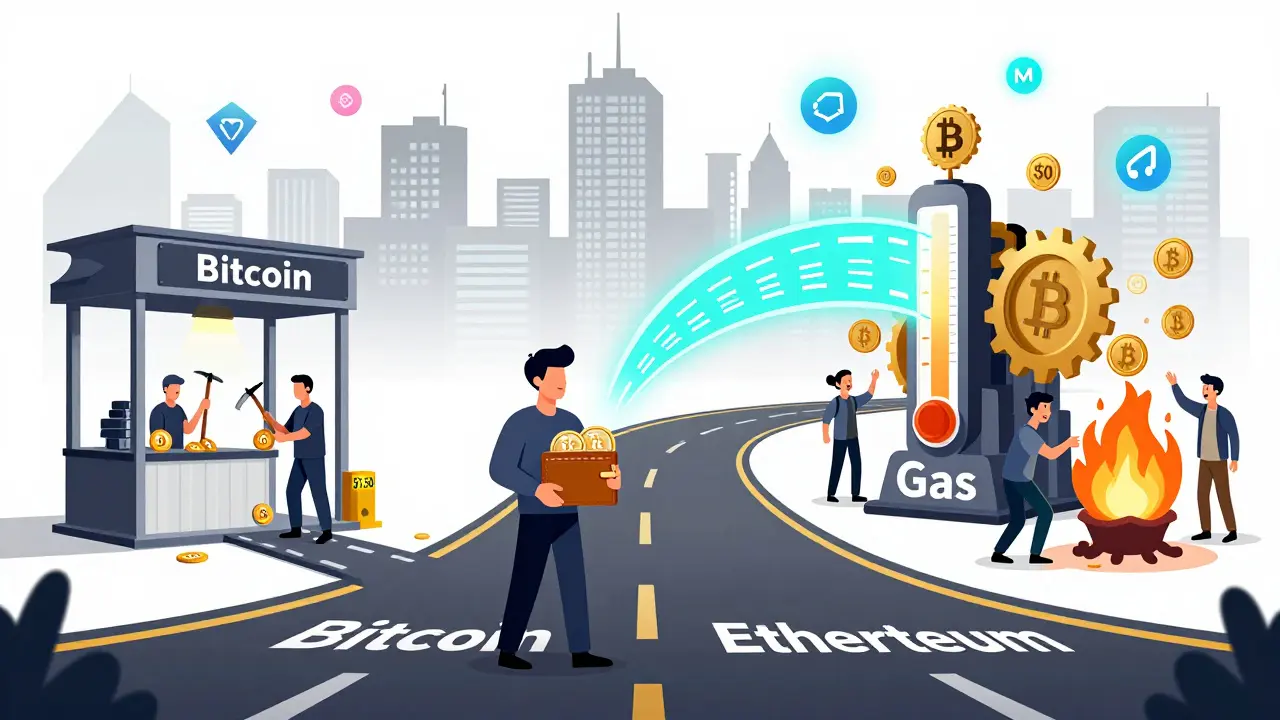
Gas Fees vs Transaction Fees: What's the Difference in Blockchain Networks
Gas fees and transaction fees are often confused, but they're fundamentally different. Learn how Bitcoin's simple fees compare to Ethereum's complex gas system-and how to save money on crypto transactions today.
Top News
-
What is BLink (BLINK) Crypto Coin? Clearing Up the Confusion 10.04.2026
-
VPN Detection Risks for Crypto Traders in Iran: How to Stay Safe 8.04.2026

-
Bitcoin in El Salvador: The Shift from Legal Tender to Voluntary Use 9.04.2026

-
What is CoTrader (COT)? A Deep Dive into the COT Token 7.04.2026
-
CRMClick Crypto Exchange Review: Is it Safe to Trade Here? 4.04.2026